Accepted Asteroid Dynamics Study
A 36.6-minute asteroid needs cohesion to hold itself together
Accepted dynamics work maps unstable terrain, possible boulder retention, and spacecraft orbits around the super-fast near-Earth asteroid 2011 UW158.
Briefed September 24, 2026 · Aliens in the Clouds
Peer-Reviewed Model · Cohesion Inferred
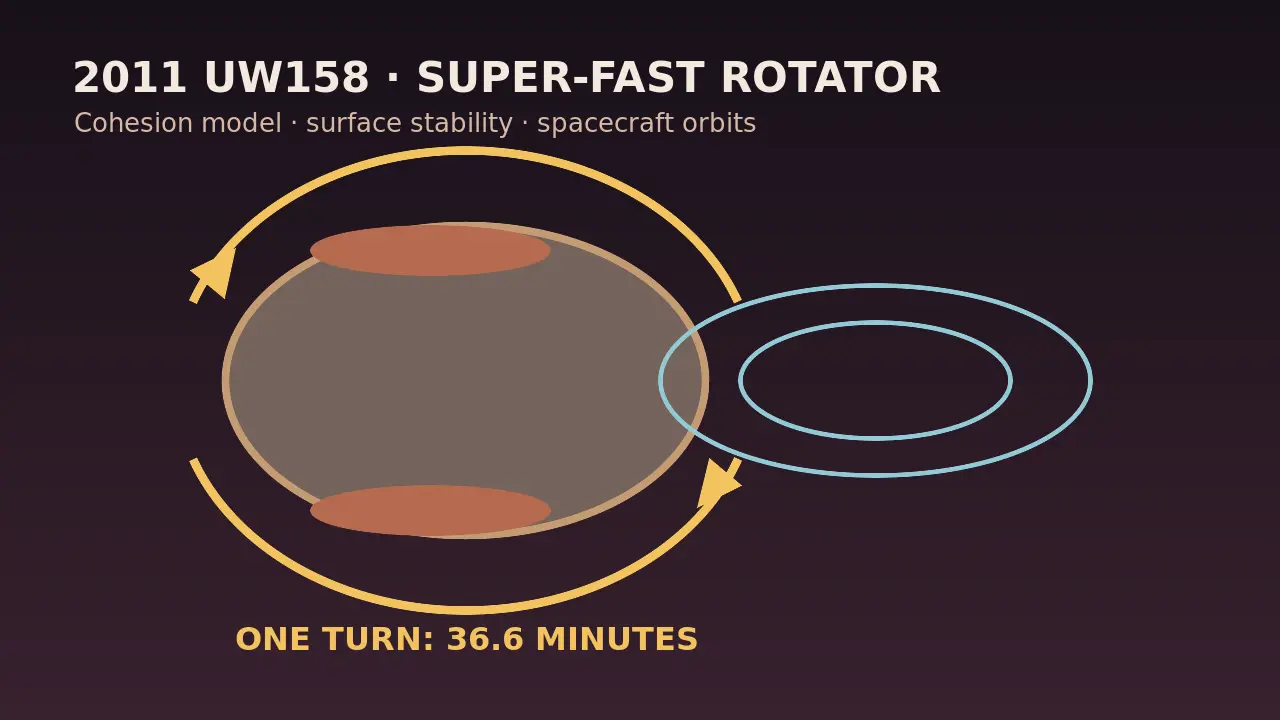
Asteroid (436724) 2011 UW158 completes one rotation in 0.61072 hours, well beyond the usual spin barrier for rubble piles of its size. Using a three-dimensional shape model, researchers calculated effective slopes, equilibrium points, surface stability, periodic orbits, and station-keeping requirements under both cohesionless and cohesion-modified assumptions.
With cohesion included, effective slopes fall to about 45 degrees and the equatorial region can retain modeled boulders up to roughly 50 meters. Centrifugal forces still push exterior equilibrium points inward and make loose regolith prone to ejection outside polar regions. The accepted study finds the behavior consistent with significant internal cohesion, but it does not directly measure the asteroid's material strength or inventory every rock on its surface.
Why it matters
Fast rotators test where gravity-only asteroid models fail, with consequences for impact-risk assessment, surface evolution, and safe spacecraft operations near small bodies.
What the source establishes
Accepted Icarus study using a measured spin period and a 3-D shape model. Surface stability, boulder size, and station-keeping costs are model results.
Published by Aliens in the Clouds. These AI-assisted summaries link to their sources and distinguish reported claims from established findings. Skinny Ed is a fictional mascot; High Thoughts are comedy. Send a correction with its source.