Preprint · Spacecraft-Origin Hypothesis
Could a ‘dark comet’ be the lost Phobos 1 spacecraft?
A new preprint finds that a spacecraft-shaped model fits aspects of 1998 KY26, but its identity remains an audacious hypothesis awaiting harder tests.
Briefed September 22, 2026 · Aliens in the Clouds
Speculative Model · Identity Unconfirmed
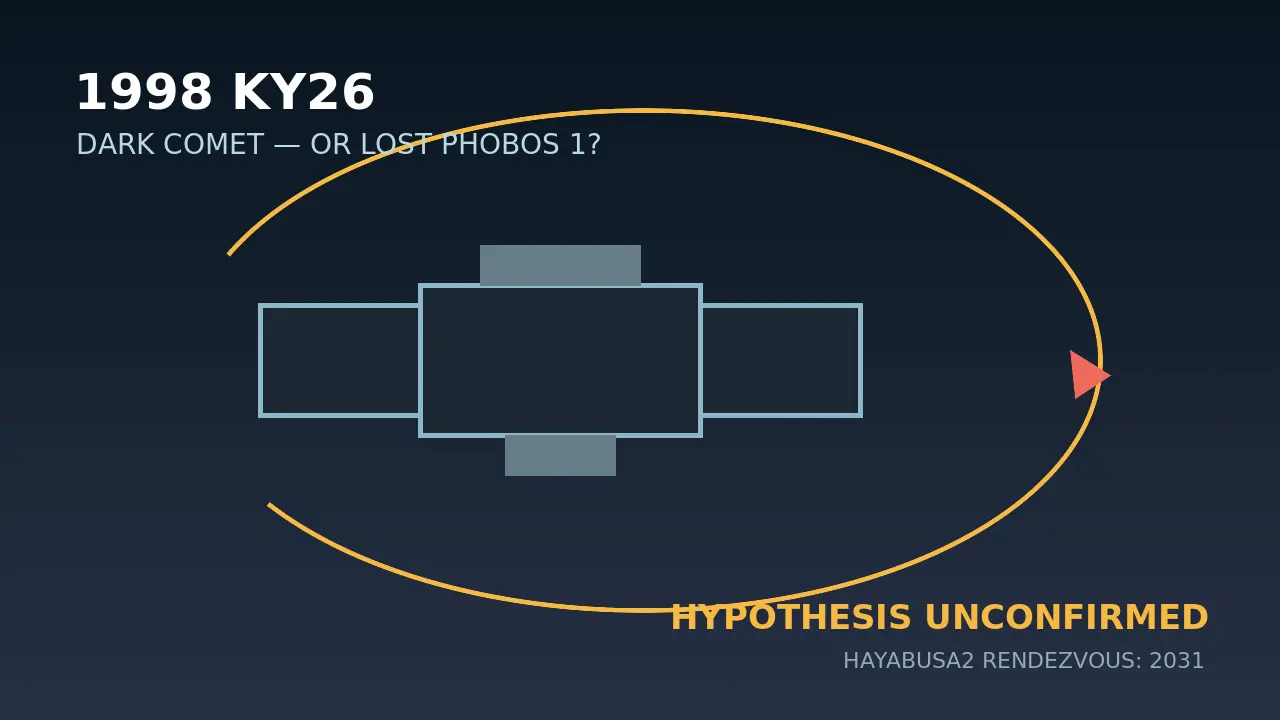
Near-Earth object 1998 KY26 is about 11 meters across, reflects roughly half the incident light, spins once every 5.3516 minutes, and shows nongravitational acceleration without detected gas or dust. A new preprint tests the proposal that the object is not a natural dark comet at all, but the Soviet Phobos 1 probe lost in 1988 and later rediscovered under an asteroid designation.
The authors report that a first-order spacecraft approximation can reproduce eight light curves, while treating the unexplained acceleration as solar radiation pressure on a cylinder or solar panels reduces residuals by about 11 percent across 260 astrometric and radar measurements. They explicitly say the analysis cannot be conclusive, and a better fit does not uniquely establish identity. JAXA's Hayabusa2 mission is scheduled to rendezvous with 1998 KY26 in 2031, offering a future opportunity to distinguish natural body from manufactured object.
Why it matters
It is a rare extraordinary claim with a named candidate, quantitative predictions, and a planned close inspection—exactly the structure that allows speculation to become falsifiable.
What the source establishes
Fresh non-peer-reviewed hypothesis and model comparison. The object's measured spin, size, albedo, and acceleration are established; identification as Phobos 1 is unconfirmed.
Published by Aliens in the Clouds. These AI-assisted summaries link to their sources and distinguish reported claims from established findings. Skinny Ed is a fictional mascot; High Thoughts are comedy. Send a correction with its source.