Exoplanet Atmosphere Research
Keck traces hydrogen beyond WASP-12 b's ordinary transit
Absorption before and after the planet crosses its star is consistent with escaping gas overflowing into extended tails.
Briefed September 17, 2026 · Aliens in the Clouds
Under Review · Extended Outflow Inferred
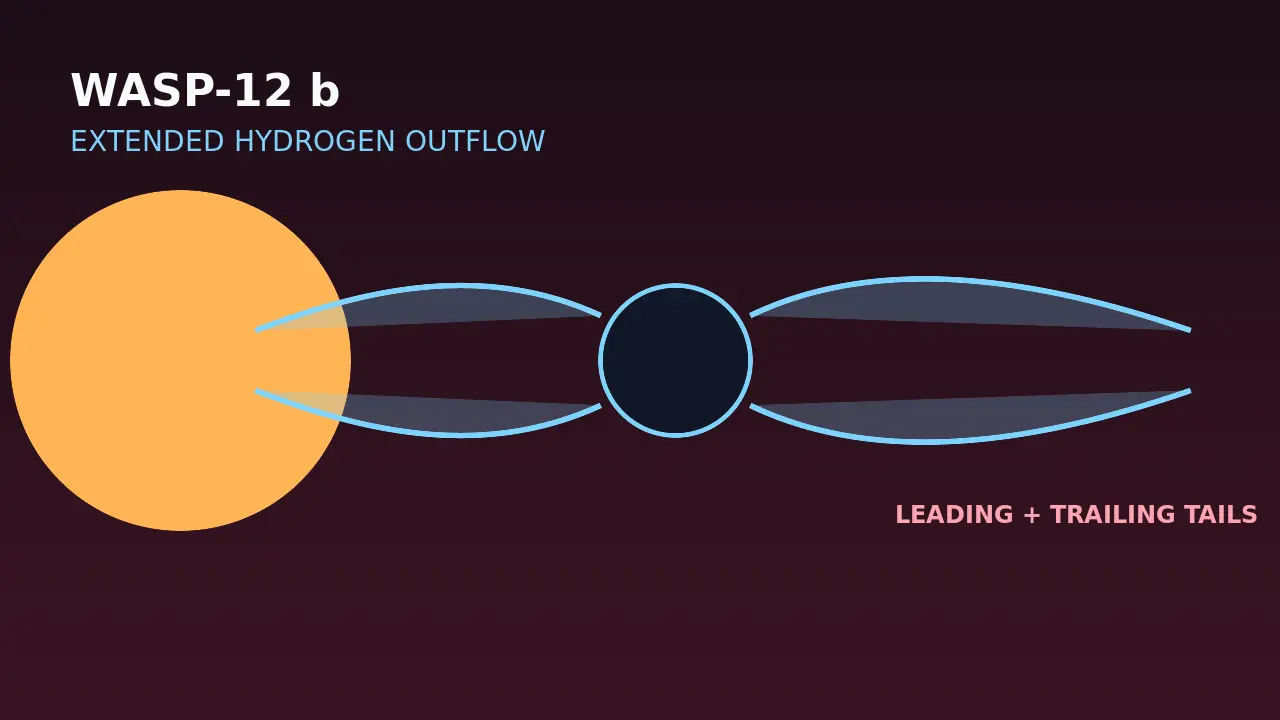
An eight-hour Keck Planet Finder observation centered on WASP-12 b's transit found hydrogen-alpha and hydrogen-beta absorption strongest during the transit, with amplitudes of 2.66 plus or minus 0.25 percent and 2.88 plus or minus 0.43 percent. The team also reports evidence of absorption before and after the planet itself crossed the stellar disk.
The authors say the timing and velocity are consistent with hydrogen overflowing the planet's Roche lobe, moving into the star's rest frame, and being tidally stretched into leading and trailing tails. Similar behavior has been seen around a few other highly irradiated gas giants. The manuscript is under review, and the outflow geometry is an interpretation of spectroscopy rather than a directly photographed tail.
Why it matters
Extended atmospheric escape can reveal how extreme stars strip planets, constrain stellar winds, and help predict the long-term evolution of close-in worlds.
What the source establishes
Under-review preprint with statistically reported hydrogen absorption. Extended tails are the physically consistent interpretation, not a direct image or a claim involving life or technology.
Published by Aliens in the Clouds. These AI-assisted summaries link to their sources and distinguish reported claims from established findings. Skinny Ed is a fictional mascot; High Thoughts are comedy. Send a correction with its source.