Recent Research
New study maps what PURSUE videos can—and cannot—measure
Researchers reviewed all 112 public sensor clips and found that none contains the complete geometry needed to recover an object’s physical velocity.
Briefed August 18, 2026 · Aliens in the Clouds
Research Finding
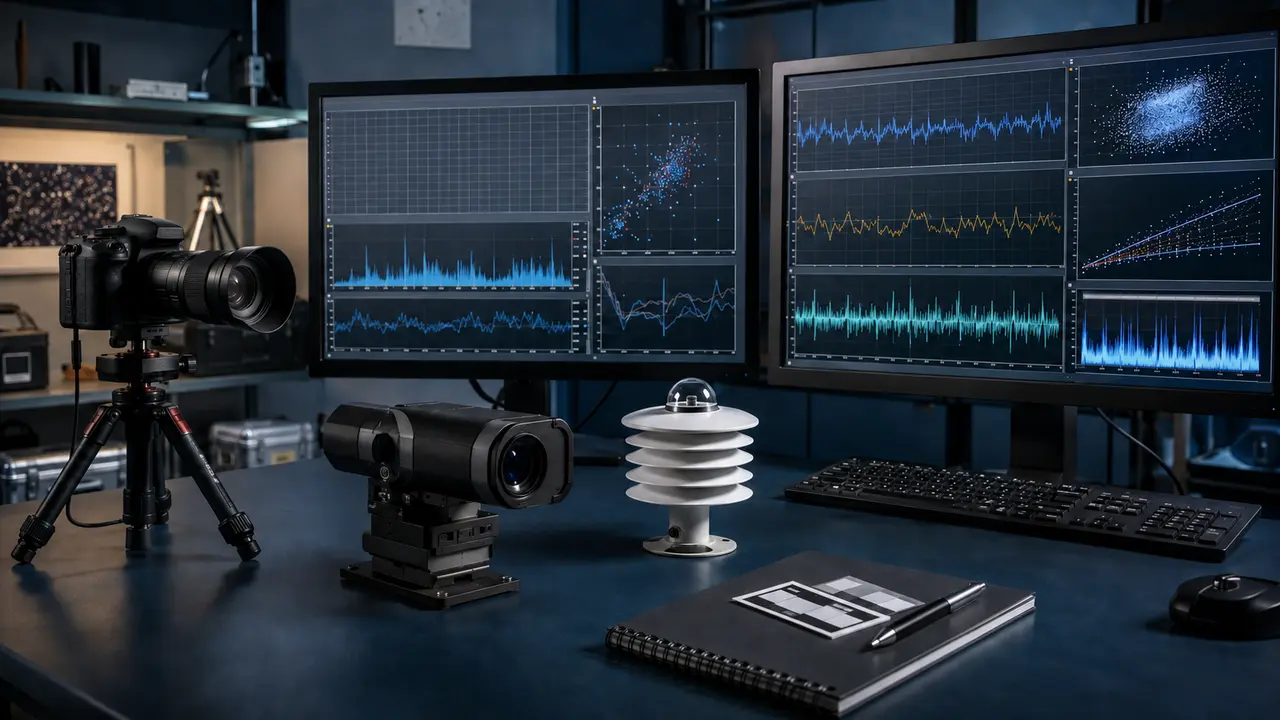
Jacob Haqq-Misra and Ravi Kopparapu analyzed the 112 sensor videos released through PURSUE. Motion in pixels can be measured, but converting it into physical speed also requires the camera’s angular scale, range to the object, the observing platform’s velocity, and the angle between the object’s motion and the line of sight. The authors found that no released clip provides that complete set.
Two cases show what partial constraints can still accomplish. PR113’s visible graticule permits an estimated field of view, but missing range and geometry leave solutions spanning a nearby bird to a much larger, faster object. In PR149, a ship of approximately known size provides a reference that limits the target’s relative speed to roughly Mach 0.3–0.4 if both are at the same range. The study concludes that the videos neither demonstrate nor exclude anomalous kinematics without additional data.
Why it matters
The paper turns a recurring argument about fast-looking dots into an explicit list of missing measurements—and shows where limited, defensible bounds are still possible.
What the source establishes
This is a new scientific analysis of released imagery, not a government resolution of the cases. Its calculations depend on stated assumptions and can be scrutinized; its central data-gap finding is directly checkable against the public clips.
Published by Aliens in the Clouds. These AI-assisted summaries link to their sources and distinguish reported claims from established findings. Skinny Ed is a fictional mascot; High Thoughts are comedy. Send a correction with its source.