Small-Body Survey Concept
Nautilus proposal links cislunar safety to the Oort frontier
A white paper combines distributed nearby telescopes with a four-meter deep-search observatory for natural small bodies.
Briefed September 12, 2026 · Aliens in the Clouds
Developing White Paper · No Detection
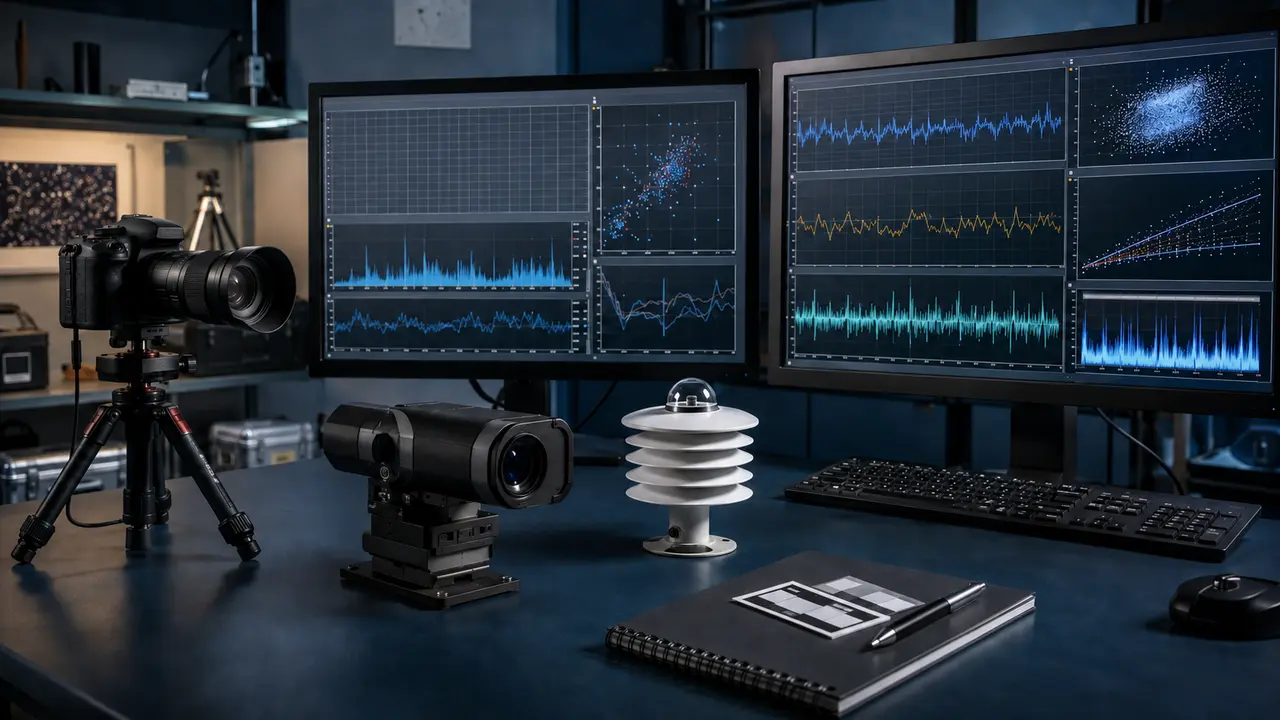
Julien de Wit and colleagues propose a two-layer observing program for natural objects from the Earth-Moon neighborhood to the Solar System's distant edge. An illustrative network of roughly 50-centimeter wide-field telescopes would detect and classify meter- to decameter-scale objects in cislunar space, monitor lunar impacts and ejecta, and maintain custody of fading objects with unresolved Earth or Moon impact probabilities.
A four-meter Nautilus Quattro Imaging unit would add precise astrometry, synthetic tracking, and surveys reaching an apparent visual magnitude near 30. The authors argue that the combination could strengthen planetary defense while mapping the poorly known transition from the Kuiper Belt to the inner Oort Cloud. This is an unreviewed white paper and illustrative architecture, not approved hardware, a funded deployment, or a report of an anomalous object.
Why it matters
Better knowledge of ordinary small bodies improves both impact readiness and aerial-orbital identification. The same survey could test how early giant planets scattered material into the Solar System's outer reservoirs.
What the source establishes
Verified new white paper. Projected capabilities and telescope distribution are conceptual; no observatory selection, detection, or extraordinary object is announced.
Published by Aliens in the Clouds. These AI-assisted summaries link to their sources and distinguish reported claims from established findings. Skinny Ed is a fictional mascot; High Thoughts are comedy. Send a correction with its source.