Temperate Exoplanet Research
Eight years of data sharpen the masses of K2-3's three planets
ESPRESSO and archival spectra separate a 40.5-day stellar rotation signal from three small worlds, including two temperate planets.
Briefed September 17, 2026 · Aliens in the Clouds
Submitted Manuscript · Masses Estimated
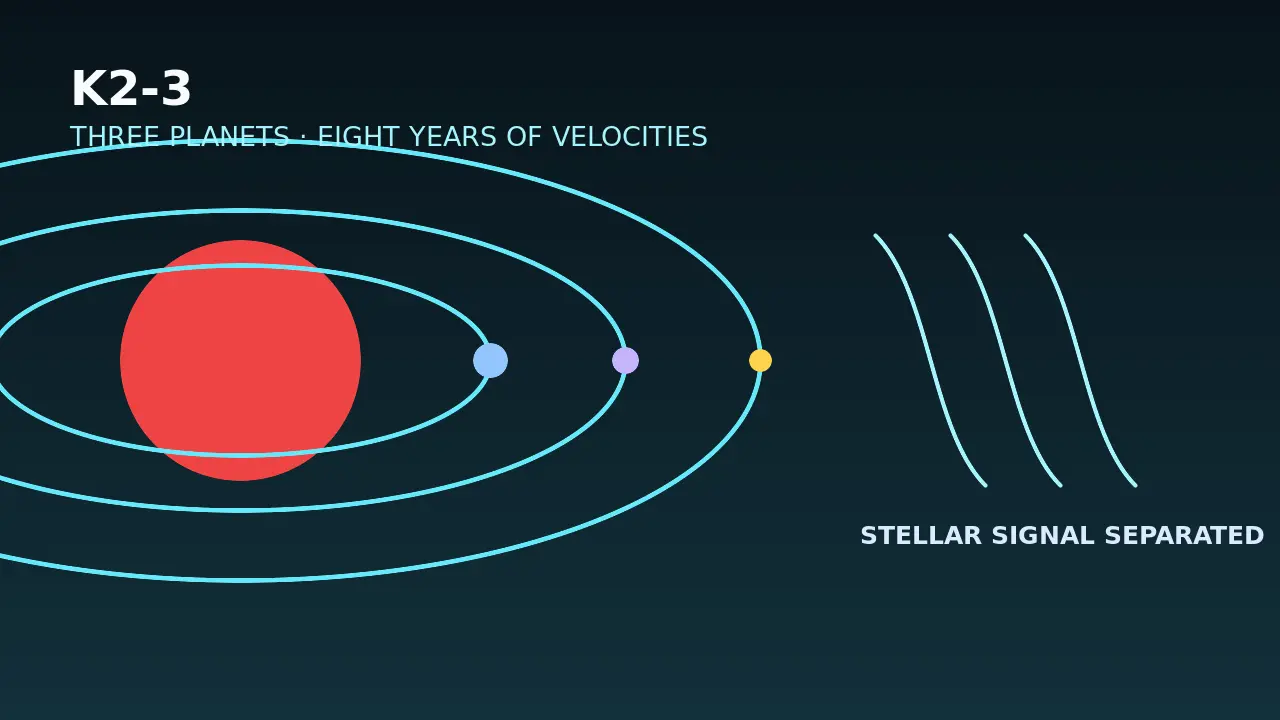
Researchers combined new ESPRESSO radial velocities with HARPS, HARPS-N, and HIRES measurements spanning eight years. A multidimensional Gaussian-process model separated the host star's 40.5-day rotation from the planets' signals and produced masses of 6.61 plus or minus 0.47 Earth masses for K2-3 b, 2.23 plus or minus 0.68 for c, and 2.12 plus or minus 1.27 for d.
The significance of planet b's mass doubled, c shifted slightly lower, and the outer planet d remains only marginally detected. The mass-radius positions favor hydrogen-helium-rich or volatile-rich compositions for b and c, while d remains ambiguous. A forward model suggests one JWST visit could distinguish a hydrogen-rich atmosphere from a water-world scenario, but no such atmospheric observation or habitability result is reported here.
Why it matters
Reliable masses are needed to interpret atmospheric spectra and determine whether small temperate planets are rocky, volatile-rich, or wrapped in light gases.
What the source establishes
Submitted manuscript using established instruments and statistical activity modeling. Planet masses are estimates, K2-3 d remains marginal, and ‘temperate’ does not mean habitable or inhabited.
Published by Aliens in the Clouds. These AI-assisted summaries link to their sources and distinguish reported claims from established findings. Skinny Ed is a fictional mascot; High Thoughts are comedy. Send a correction with its source.