JWST Detection Methods
A hidden companion reveals a fast JWST route to cold giant planets
Seconds-long calibration exposures found a nearby star—and suggest selected sub-Jupiter planets could be recovered without a coronagraph.
Briefed September 17, 2026 · Aliens in the Clouds
Submitted Preprint · Stellar Companion Detected
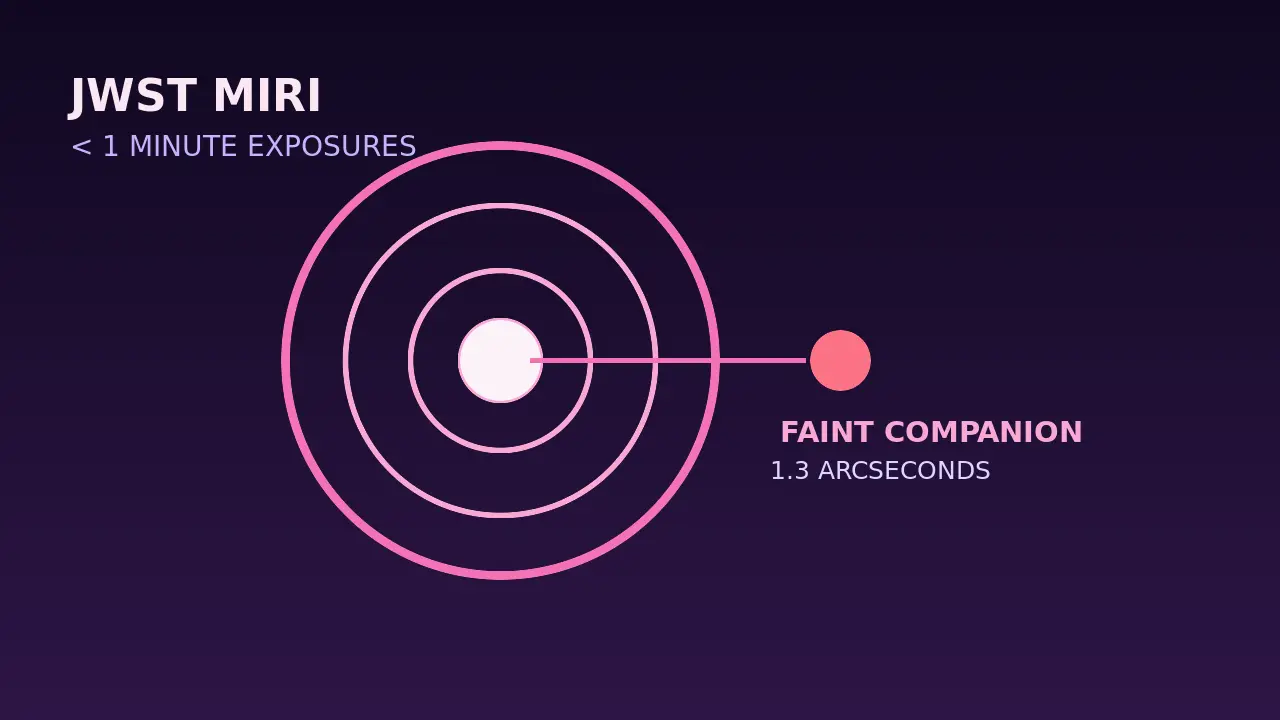
A team found a previously unrecognized stellar companion to HD 101452, an A star used as an infrared flux calibrator, in noncoronagraphic JWST/MIRI images. The companion appears in four filters between 15 and 25.5 microns at a projected separation of 1.3 arcseconds and is roughly 27 times fainter in the mid-infrared.
Using contrast curves measured from those calibration data, the researchers estimate that 17-to-42-second integrations could detect sub-Jupiter-mass planets at Solar-System-like separations around a subset of suitably bright stars within 30 parsecs—provided the reference star closely matches the target's brightness. The object actually detected here is a star, not a planet; the planetary reach is a sensitivity forecast from a submitted preprint.
Why it matters
If follow-up work confirms the performance, short archival or purpose-built MIRI observations could survey cold giant planets far more efficiently than long, specialized campaigns.
What the source establishes
Verified stellar-companion detection plus modeled planet sensitivity. No sub-Jupiter planet was discovered in this study, and the forecast depends on unusually well-matched reference-star subtraction.
Published by Aliens in the Clouds. These AI-assisted summaries link to their sources and distinguish reported claims from established findings. Skinny Ed is a fictional mascot; High Thoughts are comedy. Send a correction with its source.