Direct Exoplanet Imaging
Roman may get a decisive look at the nearest Jupiter analog
A combined orbit-and-atmosphere model puts Epsilon Eridani b near 0.91 Jupiter masses and turns a future non-detection into a meaningful test.
Briefed September 17, 2026 · Aliens in the Clouds
Submitted Preprint · Signal Model-Dependent
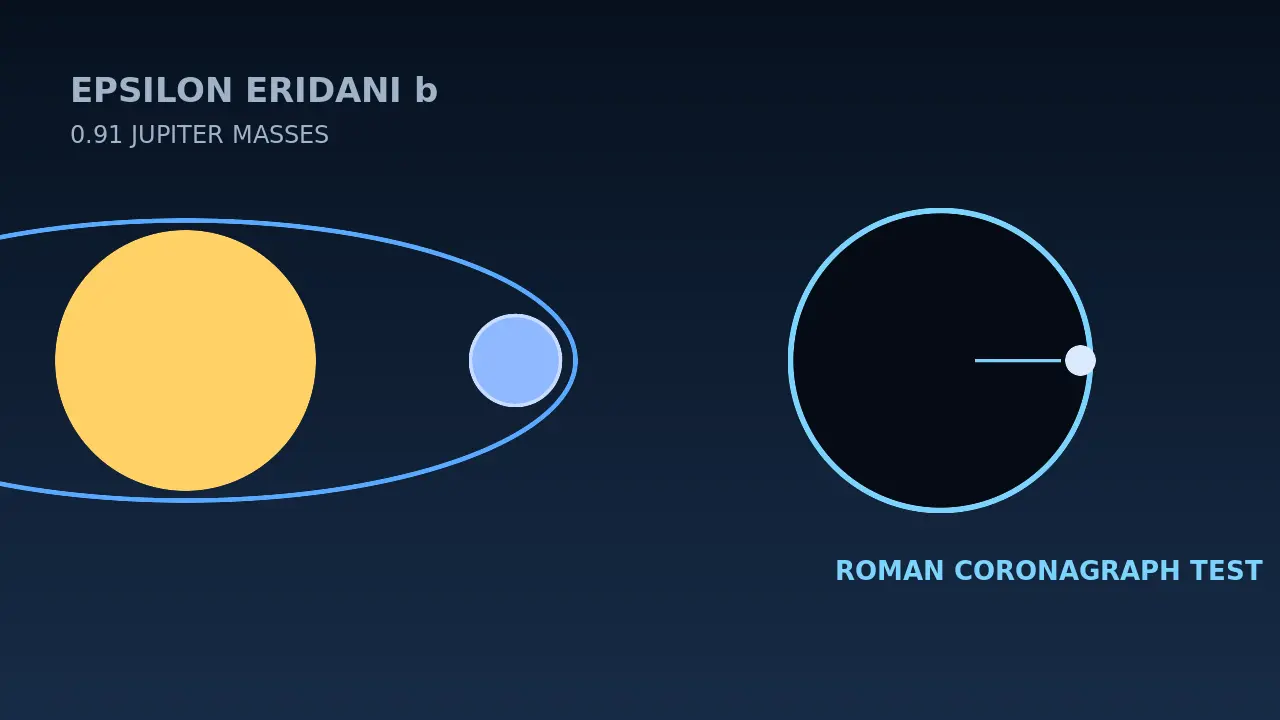
Researchers combined new radial-velocity measurements, updated absolute astrometry, and JWST/NIRCam imaging limits in one Bayesian model of Epsilon Eridani b. The submitted study estimates a mass of 0.91 plus or minus 0.06 Jupiter masses and finds an orbit consistent with earlier work.
The atmospheric result depends strongly on assumptions. Under chemical equilibrium, a low-significance feature in one JWST epoch is recovered as the planet at high confidence; under disequilibrium chemistry, one allowed solution is consistent with no detected flux. When the team projects its models to NASA's Roman Coronagraph, every cloudy atmosphere it currently permits should be bright enough to test. The current work is a model-based forecast, not a new confirmed image of the planet.
Why it matters
Epsilon Eridani is nearby enough to make a familiar Jupiter-like world a practical proving ground for direct imaging, atmospheric models, and Roman's coronagraph.
What the source establishes
Submitted preprint combining real observations with model-dependent atmospheric inference. The orbit and mass are constrained; the tentative flux feature and cloud properties are not yet secure detections.
Published by Aliens in the Clouds. These AI-assisted summaries link to their sources and distinguish reported claims from established findings. Skinny Ed is a fictional mascot; High Thoughts are comedy. Send a correction with its source.