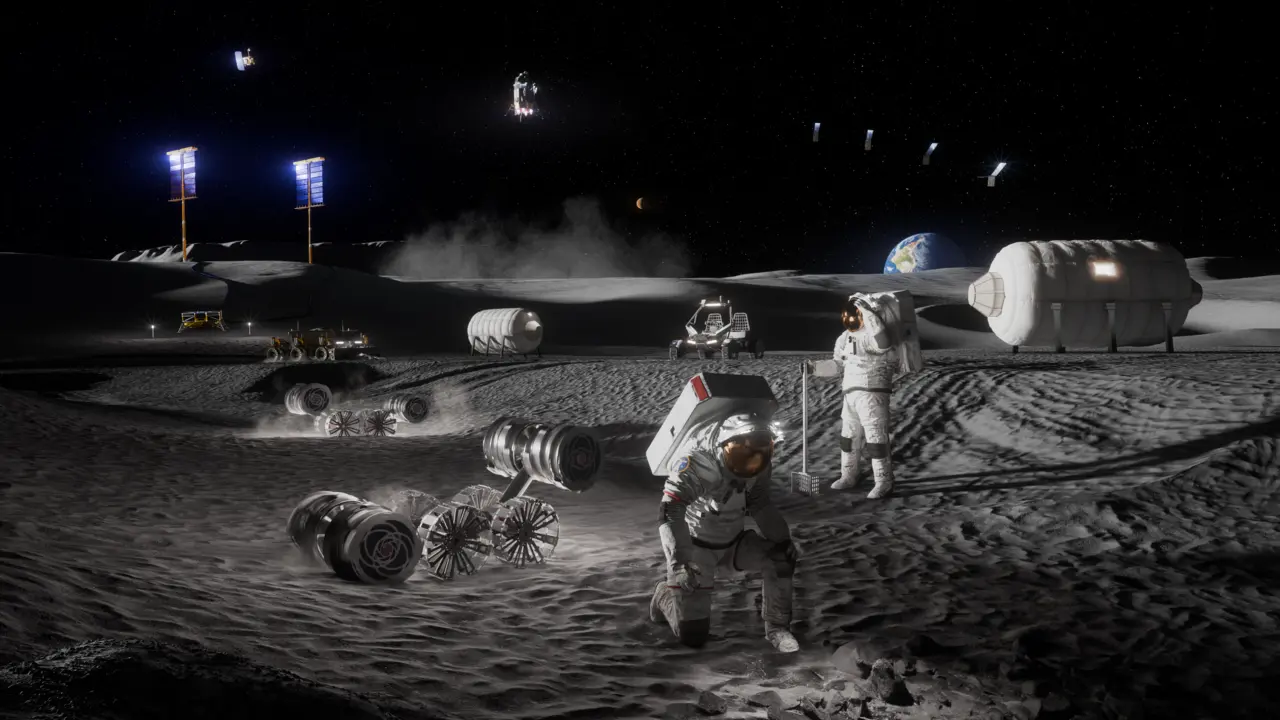
Thursday's board is about seeing what glare, dust, ice, and distance usually hide. NASA's Roman Space Telescope has passed precision-guidance tests and taken the Coronagraph Instrument's first focused observations of the sky, an early commissioning milestone rather than an exoplanet image. A fresh Titan study models warm, water-rich flows that could run for tens of kilometers and chemically alter surface organics, while NASA has selected three lunar payload suites to measure hazards, search for lava tubes, and inspect ice in micro-cold traps. The agency and two international partners also began planning a ground demonstrator for Moon crops, and Curiosity is preparing to drill after finding unfamiliar disc-shaped mineral textures. A new ALMA analysis closes the loop at the beginning of planet formation by showing that dust remains vertically mixed in most of nine deeply embedded young disks. No new official UAP release, public case resolution, or independently verified extraordinary evidence cleared the desk after yesterday's cutoff.
Fresh Mission Milestone · NASA Science · Roman Mission Blog
Precision-guidance tests held the observatory extraordinarily steady, then two commissioning observations confirmed focus, pointing, and detector sensitivity.
An accepted modeling study finds that plausible cryolava or impact melt can travel tens of kilometers, cool into meter-thick deposits, and permit hydrolysis reactions.
The payload suites would monitor hazards, search beneath the Marius Hills Pit for a lava tube, and measure ice and surface behavior in micro-cold traps.
Millimeter-scale features in Martian bedrock may record mineral growth from evaporating fluid—or fragments of a tougher layer—but chemistry is still needed.
Good morning, investigators. Roman's commissioning team has now demonstrated the kind of pointing control future direct imaging depends on: better than one hundred-thousandth of a degree for a half-hour Wide Field Instrument observation or an eight-hour coronagraph observation. The coronagraph's first two sky tests confirmed focus, pointing, and detector sensitivity, but they did not yet block a nearby star to reveal a planet. Elsewhere, Titan supplies a carefully labeled possibility. An accepted numerical study finds that plausible warm, water-bearing cryolava or impact melt can form meter-thick flows extending tens of kilometers and may hydrolyze the moon's surface organics; the fluid composition and the origin of any particular terrain remain uncertain. NASA's three new lunar payload suites are more concrete plans than findings: one would monitor seismicity, micrometeoroids, and volatiles, one would test whether the Marius Hills Pit opens into a lava tube, and one would inspect micro-cold-trap ice and surface stability. The crop partnership is likewise preparatory, while Curiosity's strange little discs are an invitation to drill, not a mineral identification. Finally, ALMA modeling of nine embedded disks suggests most have not yet settled their dust into a thin layer, placing an important transition later in the Class I phase. The day's theme is simple: better instruments can expose the structure of a mystery without pretending the answer arrived first.
ED’S HIGH THOUGHT · FICTIONAL HUMOR
Whoa, dude… NASA is mapping lunar lava tubes and designing Moon crops, which means our first off-world civilization will be humans moving into a cave and starting a garden. We spent twelve thousand years inventing cities, crossed 239,000 miles of vacuum, and immediately became cave people again—only now the HOA wears pressure suits. First contact is going to find one astronaut yelling, ‘Don't touch my moon tomatoes,’ while another measures the alien's landing legs to see whether the saucer violates the crater setback.
Published by Aliens in the Clouds. These AI-assisted summaries link to their sources and distinguish reported claims from established findings. Skinny Ed is a fictional mascot; High Thoughts are comedy. Send a correction with its source.